
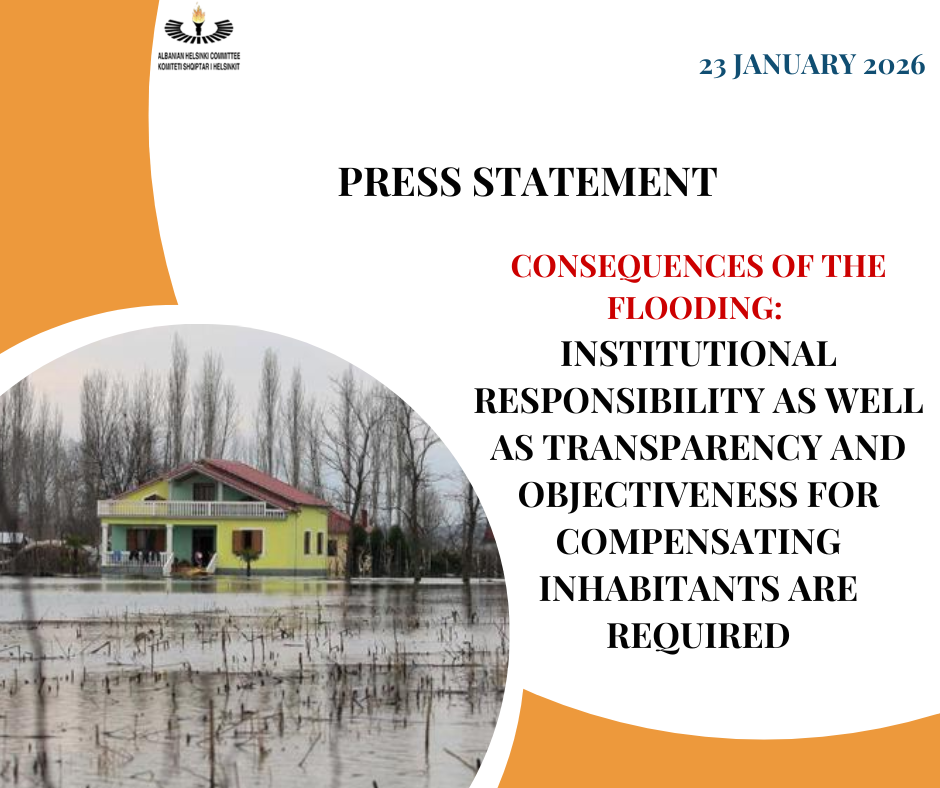
On 16.01.2026, a group of observers of the Albanian Helsinki Committee conducted a partial monitoring for the verification of the situation of the massive flooding of January 6 that had engulfed several cities of Albania for a number of days. The monitoring was conducted in the Durrës Municipality, where meetings were held with the inhabitants of the “Këneta” area and monitors observed in the filed their living quarters. Furthermore, monitors also held meetings with representatives of local authorities, including the Administrator of Administrative Unit no. 6, the Prefect of Durrës County, the representative of the Directory for Rural, Agriculture, and Civil Emergency Services at Durrës Municipality.
Based on the findings of this monitoring as well as on the fact that the flooding also affected other cities of the country, but also the importance of the right to a calm family life and the positive obligations that the state has for protecting the lives and health of citizens, AHC is hereby sharing a few concerns and recommendations, as follows:
Local authorities refer as a main cause of the flooding the throwing of waste without any criteria by citizens or interventions into the infrastructure of the drainage systems. AHC considers that in order to reach an objective conclusion, there needs to be a comprehensive verification, looking at the carrying out of duties by institutions tasked with cleaning up and maintaining the drainage system, as well as institutions whose duty it is to protect the environment, in accordance with the principle “the polluter pays.” The state may not discharge all blame to the inhabitants but should also take its own responsibilities by informing whether local authorities have rigorously carried out their duties and responsibilities in this regard. Furthermore, inhabitants need to be sensitized in a continuous manner.
It is worth emphasizing that according to law no. 139/2015 “On local governance,” in the field of infrastructure and public services, municipalities are responsible in the territory of their jurisdiction for the collection, removal, and treatment of rain waters and protection from flooding in inhabited areas, the construction, rehabilitation, and maintenance of roads, the collection, removal, and treatment of solid and home waste (according to article 23 of this law) as well as for caring for and preventing unlawful interferences in the network of water supply and drainage and sewage systems, of protection canals in inhabited areas, as well as the network of third-level canals for irrigation and drainage.
The situation created by the flooding of the start of this year requires the drafting of a plan of structural and non-structural measures by all local government units at the national scale, in order to prevent other massive flooding in the future, when they are linked only with the system of unauthorized interventions in the city’s drainage systems, in accordance with the provisions of Chapter II, of law no. 45/2019 “On civil protection.”
Part of the citizens who were asked said they were not informed about the procedures that they needed to follow with local authorities in order to get the relevant compensation. The rest of the inhabitants who had submitted a copy of documentation required for the assessment of damages, had not been made available a copy of the process-verbal drafted by the committee in the field on stating the damages and were not familiar with how the process of compensation would continue further. Citizens need to be sensitized in accordance with the principle of equality, about the procedures that they need to follow to seek damage compensation, while authorities need to maintain documentation that enables transparency both for citizens and for the institution itself, at the moment they carry out any verifications at places of residence for the purpose of assessing damages. Informing the public and the community endangered by natural disasters about the process of assessing risk is one of the main duties that article 28, 30 of law no. 45/2019 “On civil protection” has assigned to the Prefect of the County and the Municipalities.
Based on the situation of vacancies found at the structure of Administrative Unit No. 6 (two inspectors were lacking and the administrator was tackling the created workload himself, while it was estimated that about 1200-1300 heads of families had shown up to inform about the situation), we emphasize that the Administrative Units should be equipped with necessary personnel to cope with civil emergencies and the administration of complaints and requests by inhabitants.
AHC also considers that the showing up of working groups in the field, established by the Municipality, with a distance of time from the moment when the flooding occurred, might affect the objectiveness of the assessment of damages for each place of residence, by leading to the increase or decrease of their real value.
Although based on Order no. 01, dated 06.01.2026, of Durrës Municipality, it was envisaged that the deadline for concluding the drafting of process-verbals and the technical-legal documentation by the committee, is five days from its establishment, until the time of the monitoring by AHC, the procedure for the assessment of damages had not yet concluded, while there was no fixed date as to when the goal was for concluding the process, in order for the Municipal Council to establish the overall amount of damages and then conduct the verification of this act by the Prefect of the County, in accordance with the provisions of article 8 of law no. 107/2016 “On the Prefect of the County.”
Lastly, AHC stresses the need for carrying out the process for the assessment, establishment of the value of damages, and the distribution of compensation by the Council of Ministers in accordance with the principles of efficiency, effectiveness, and economicity, within a reasonable deadline, given that some of the inhabitants stated that a similar situation of flooding had also occurred three years earlier, but the compensation had been given out late, about two years later. For this suggestion, we are based on the difficult social-economic conditions of some of the contacted families and the damages sustained.